
 01980 677 000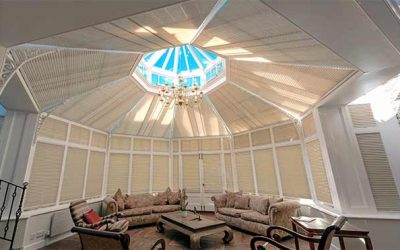












Balancing Comfort Year-Round: Blinds Fabric and the Dual Impact on Solar Transmittance and Insulation
Introduction: Understanding blinds solar transmittance and insulation is vital to ensuring you have a greater appreciation of how blinds fabrics technology can help you to a more comfortable environment.
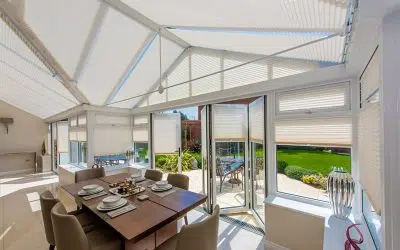
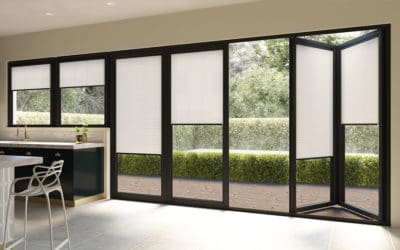
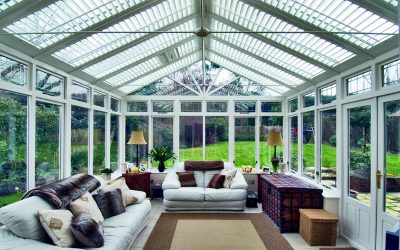
Modern buildings are embracing larger glazing systems to welcome natural light and harness solar energy, unlocking numerous benefits. However, this design approach also introduces challenges, including potential overheating in the summer and heat loss during the winter. Spaces like conservatories, orangeries, roof lanterns, apex windows, and large bi-folding or sliding doors require a delicate balance to enhance positive aspects while mitigating potential downsides.
Understanding Heat Gain For Blinds Solar Transmittance And Insulation:
Heat gain, influenced by solar radiation, long-wave infrared radiation, and internal heat sources, plays a crucial role in shaping the temperature within a space. Balancing these factors is essential for maintaining optimal comfort.
Contributory Factors:
Considerations vary depending on factors such as a south-facing conservatory experiencing substantial daily heat gains in summer without contributions from heating appliances. Conversely, a north-facing room in winter may rely on central heating, lights, and people for warmth. Managing excessive heat gains is critical to preventing overheating and maintaining a comfortable environment with the installation of blinds playing a crucial part in ensuring maximum comfort during the summer and insulation capabilities in the winter months.
Alleviating Solar Heat Gain with Blinds Fabric:
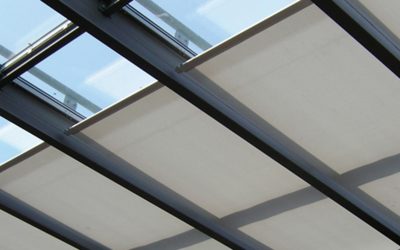
Blinds fabric plays a pivotal role in managing solar heat gain throughout the year. The total solar heat transmittance into a space account for direct transmission through the fabric and absorption by the fabric, which is later re-emitted into the enclosed space. Read our blog: Thermal Blinds And Conservatory Insulation and how thermal blinds can revolutionise conservatory insulation.
Assessing Fabric for Blinds Solar Transmittance and Insulation:
Total solar energy transmittance (Gtot) evaluates the performance of solar protection devices like blinds and shutters. It quantifies the percentage of solar energy incident on the fabric that is transmitted into the building, encompassing both the transmittance of the solar protection device and the glazing.

Key Performance Figures: This guide explores two critical energy performance metrics—g-value and Gtot—to gauge the solar energy transmitted into a building.
- G-Value (g):
-
- Definition: G-value measures the solar energy transmittance of glass, representing the ratio of total solar energy transmitted through glazing alone to the total incident solar energy.
- Example: Clear single glass typically has a g-value of 0.85, indicating that 85% of the energy is transmitted into the building through glazing. A lower g-value implies reduced heat entry and lower heat gain.
- Gtot Calculation:
-
- Methods: Gtot, indicating combined solar heat gain from glazing and shading, is calculated through two methods:
-
-
- Simplified calculation method EN ISO 52022-1
- Detailed calculation method EN-ISP 52022-3
-
Fabric Ratings Explained
Solar shading products are an essential part of helping to control levels of heat and light. The levels of Reflectance (R’s), Transmittance (T’s) and Absorptance (A’s) can vary depending on the type of material, colour, thickness etc. The total will always add up to 100% of Solar Irradiance.
Example: If a blind fabric receives a Gtot rating of 0.38, it means that in laboratory tests, it demonstrated 38% energy efficiency in transmitting heat into the building. Essentially, the blind acts as a barrier between the glazing and the room, either reflecting heat away during warmer months or providing insulation during winter. See data below:
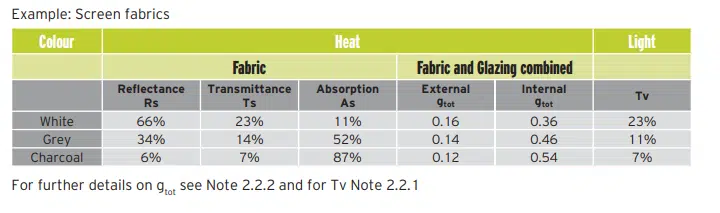
Source: https://bbsa.org.uk/wp-content/uploads/2021/03/BBSA-Training-Guide-FABRICS.pdf
The data in the table above, shows that the white coloured fabrics reflects 66% of the heat and absorbs 11%, compared to charcoal coloured fabric that reflects 6% and absorbs 87%. This shows that lighter colours are better at reflecting heat however when the light transmission (Tv) is taken into consideration at 23%, compared to charcoal at 7%, there may be an issue with possible glare issues during the summer months when the sun is at it’s strongest. Conversely, the charcoal screen fabric would reduce glare but the absorption rate is at 87%, meaning it will absorb heat and re-radiate the heat into the room if fitted internally.
Performance Data
Source of performance data It is important to use accurate data to assess the energy performance of different types of shading in combination with different types of glazing.

The above data reflects the Gtot affect blinds have on glazing. A well fitted internal blind can improve Gtot on double glazing by up to 25% and on an external blind such as an awning by up to 70%. Solar Control Glazing will also see substantial improvements on Gtot ratings by up to 8% on an internal blind and 22% on an external blind.
White and lighter colours reflect more solar energy and absorb less will therefore improve solar transmittance more than darker colours which reflect less energy and absorb more. For greater improvements on solar transmittance and insulation, blackout fabrics will increase performance.
The graph below shows improvements visually.

All Oakhurst, fabrics are sourced to comply with Gtot ratings to ensure that we offer the right fabric for the outcome your are looking for. Our pleated and honeycombe conservatory blinds for both roof and sides are specially selected based on over 30 years experience to ensure you get the most from your fabrics to ensure all year round comfort for enjoying your conservatory, orangery or roof lantern in the hot summer months and insulating in the cold winter months.

